Interpretable video generation evaluation

VGIF-Score

Diagnostic evaluation of spatio-temporal instruction following, from atomic prompt constraints to causal failure propagation.

Songyu Xu, Xin Wang, Qiang Chen, Xinran Wang, Muxi Diao, Yuxuan Zhang, Kongming Liang, Rui Lin, and Zhanyu Ma

223dependency-rich prompts
3,656ST-DAG nodes
3,940dependency edges
4.3Kfine-grained evaluation items
14video generation models

The evaluation framework

One score, two complementary signals.

VGIF-Score evaluates whether a generated video completes the requested structure and whether the result satisfies prompt-conditioned perceptual criteria.

01

Objective completion

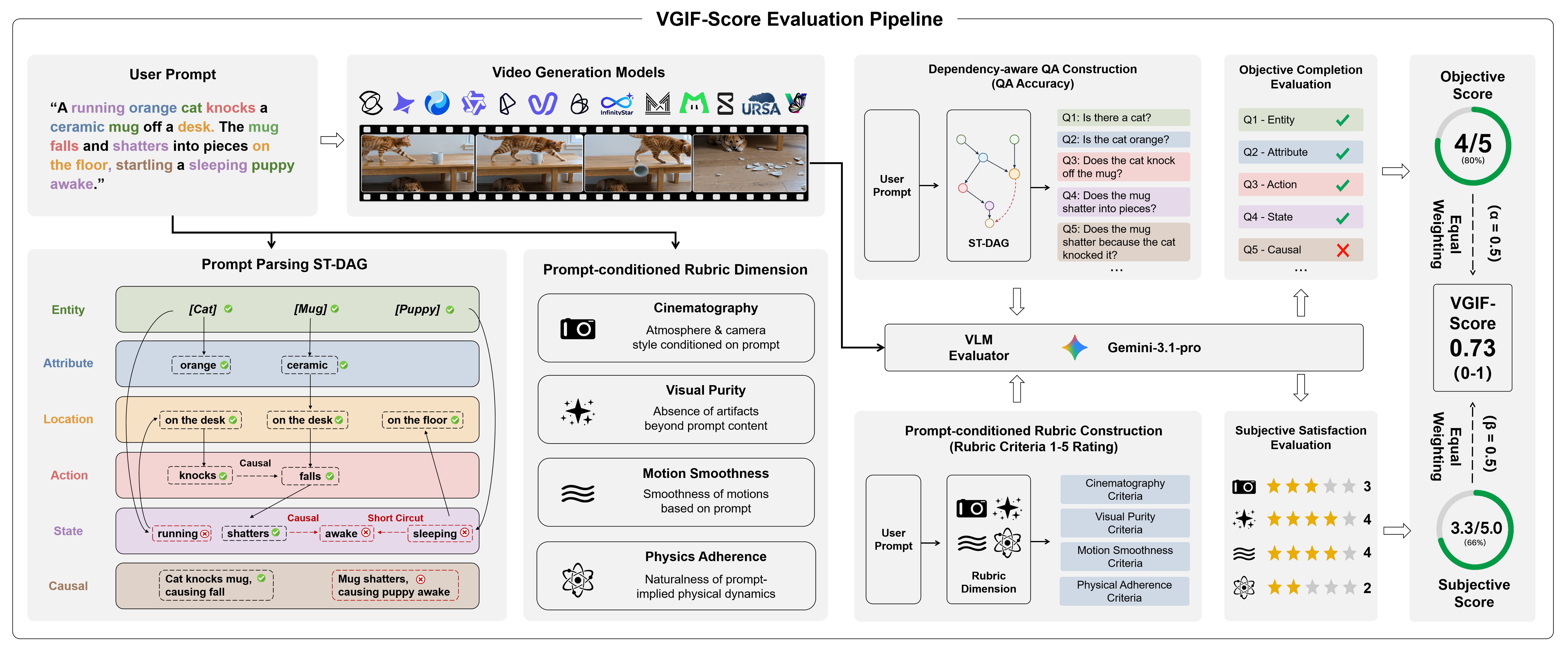
Prompts are decomposed into an ST-DAG of entities, attributes, locations, actions, states, and causal relations. A node receives credit only when its QA answer and dependency expression both pass.

Entity Attribute Location Action State Causal
02

Subjective satisfaction

An instruction-conditioned AutoRubric scores four dimensions from 1 to 5: cinematography, visual purity, motion smoothness, and physics adherence.

Cinematography Visual purity Motion smoothness Physics adherence
VGIF-Score evaluation pipeline showing prompt parsing, ST-DAG construction, dependency-aware QA, prompt-conditioned rubric construction, VLM evaluation, and the combined score.
Framework overview. The objective and subjective branches are evaluated per prompt-video pair and combined with equal weighting before benchmark-level averaging.

VGIF-Bench

Long prompts with explicit structure.

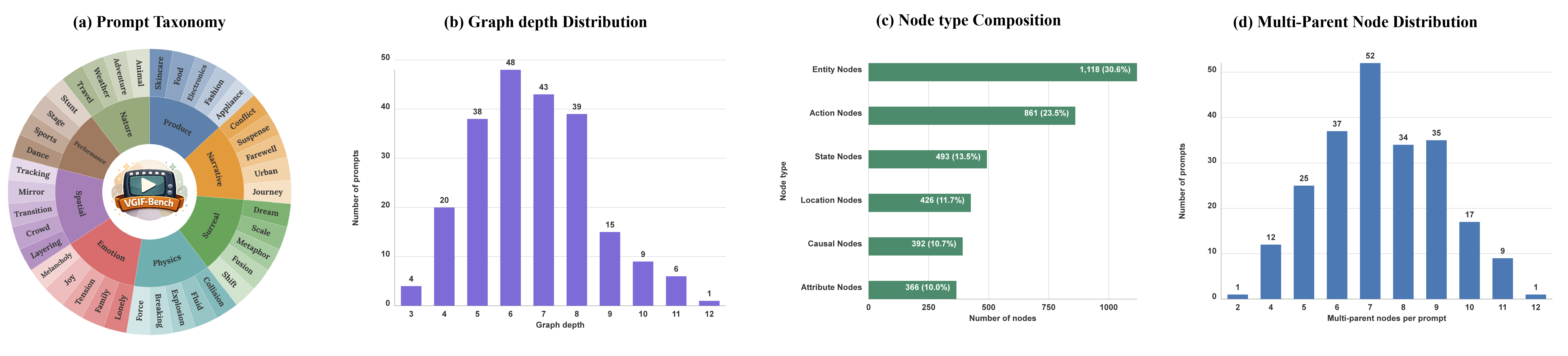
The benchmark spans eight macro categories and 38 micro categories, with deep graphs and multi-parent dependencies designed to expose instruction-following failures.

VGIF-Bench statistics showing scenario categories, graph depth, node-type distribution, and multi-parent node counts.
Benchmark composition. The original figure used in the camera-ready paper summarizes category coverage, graph depth, node distribution, and structural entanglement.

Interactive diagnosis

One prompt, traced from instruction to failure.

Compare two generated videos from the paper case study, inspect the atomic ST-DAG decomposition, and see how one missed trigger changes every downstream judgment.

Selected case Creative & Surreal Expression
Loading the prompt and diagnostic annotations...
Generated video
Passed Missed Dependency blocked
QA--
Objective--
Subjective--
Sample VGIF--
Dependency-aware QA

ST-DAG trace

Select a node
Q1 Passed

Atomic node

Select a node to inspect its evaluation question.

Dependency
None
Evidence
--

Instruction-conditioned AutoRubric

Prompt-specific criteria, not a generic quality checklist.

Each dimension is generated from this prompt. Switch dimensions to inspect the criteria, score anchors, and the selected model's diagnostic judgment.

Selected model rating -- / 5

Loading rubric...

Prompt-specific criteria

    Evaluator diagnosis

    Selected qualitative case from the camera-ready paper. Only these two generated videos and their diagnostic annotations are published here.

    Paper results

    Interactive leaderboard

    Explore the aggregate scores reported in Table 2. No per-sample evaluation outputs are included.

    Model group
    Chart metric
    Ranked comparison

    VGIF-Score

    Score / 100
    Rank Group

    All values are the aggregate percentages printed in the finalized paper. Click a column label to sort.

    Domain analysis

    Eight domains, 38 fine-grained capabilities.

    Switch between the camera-ready macro-domain table and a finer diagnostic view aggregated over the 38 micro domains.

    Domain level
    Model group
    Macro domain ranking

    Product

    VGIF / 100

    Model x domain heatmap

    Eight macro domains from the camera-ready paper.

    8 domains

    Diagnostic findings

    Where instruction following breaks.

    The graph structure reveals failure modes hidden by a single holistic quality score.

    < 5

    Causal bottleneck

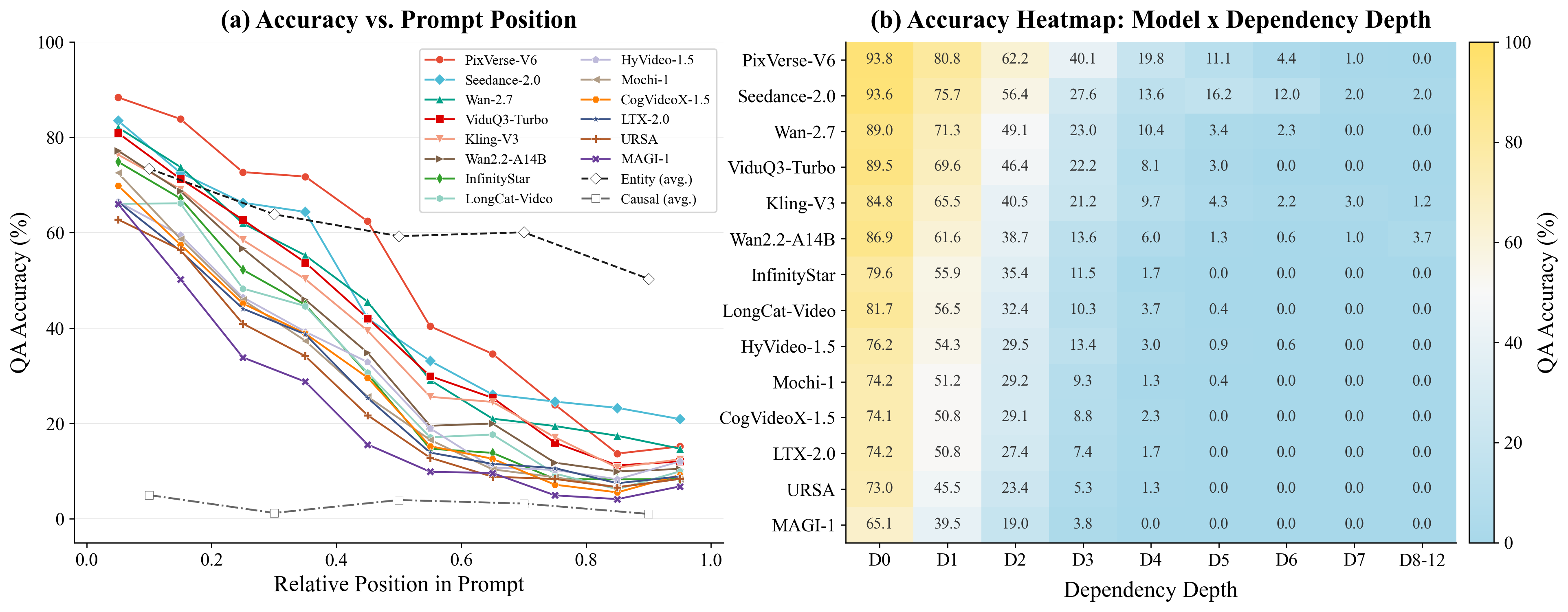
    Even the strongest commercial models score below five on causal instruction following.

    6.7x

    Prompt-position decline

    Average QA accuracy falls from 67.9% in the first fifth to 10.1% in the final fifth.

    < 3%

    Deep dependency collapse

    Beyond depth four, accuracy falls below three percent for every evaluated model.

    Line chart of QA accuracy by prompt position and heatmap of model accuracy by dependency depth.
    Structural factors. Accuracy degrades with both later prompt position and greater dependency depth, exposing two orthogonal sources of instruction-following failure.

    Failure localization

    A missed trigger blocks the causal chain.

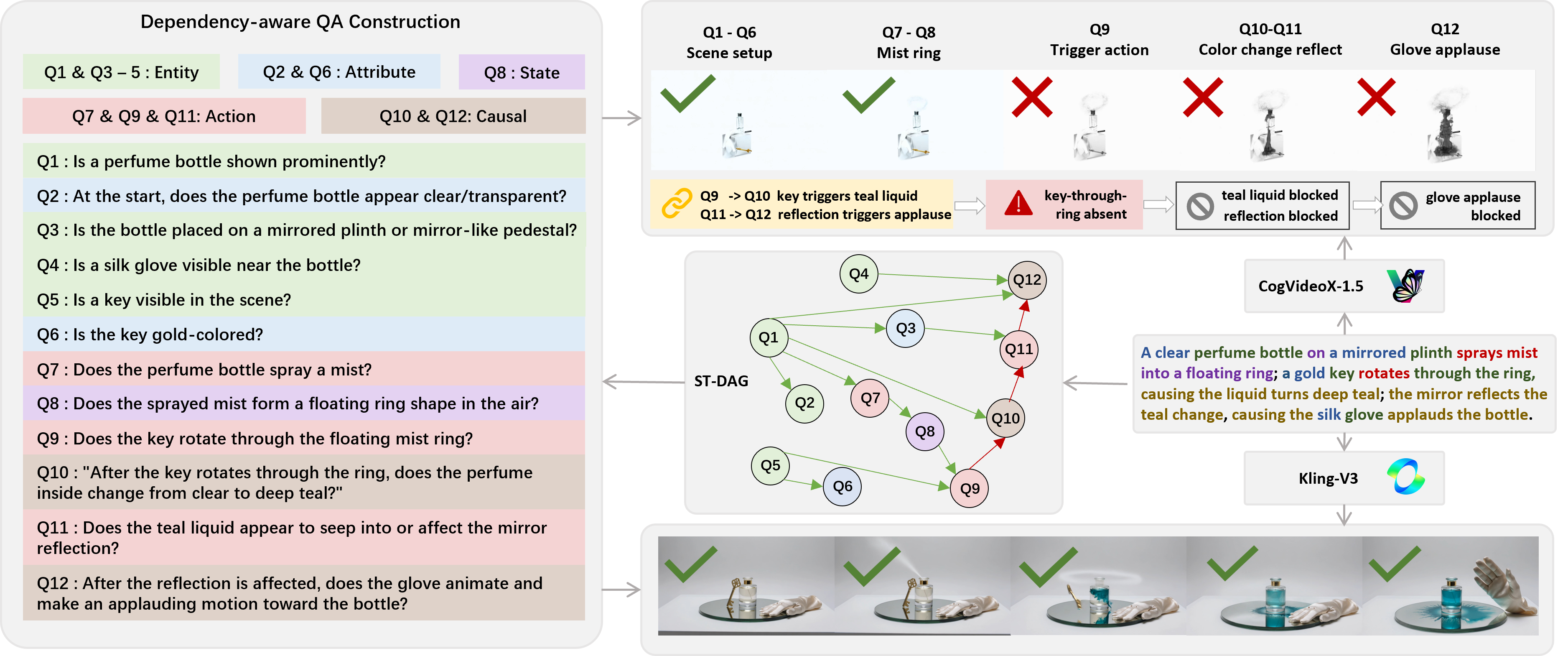
    Kling-V3 completes all 12 QA items in the paper case study. CogVideoX-1.5 preserves the scene setup but misses q9, causing dependency-aware failures at downstream q10 and q12.

    Dependency-aware causal chain case study comparing CogVideoX-1.5 and Kling-V3 on a perfume transformation prompt.
    Dependency-aware causal chain diagnosis. The ST-DAG identifies the bridge action that fails, then makes the downstream impact explicit.

    Human validation

    The combined score best matches overall human judgment.

    96.3%ST-DAG QA agreement
    0.92Cohen's kappa for QA
    0.89VGIF vs. human-overall Spearman rho

    Use VGIF-Score

    Paper, code, and benchmark.

    Reproduce the evaluation protocol with the public implementation and load VGIF-Bench directly from Hugging Face.

    Citation

    @misc{xu2026vgifscoreinterpretablediagnosticevaluation,
      title={VGIF-Score: Interpretable and Diagnostic Evaluation of Spatio-Temporal Instruction Following in Video Generation},
      author={Songyu Xu and Xin Wang and Qiang Chen and Xinran Wang and Muxi Diao and Yuxuan Zhang and Kongming Liang and Rui Lin and Zhanyu Ma},
      year={2026},
      eprint={2607.13527},
      archivePrefix={arXiv},
      primaryClass={cs.CV},
      url={https://arxiv.org/abs/2607.13527},
    }